What Is an AI Brain for Business? (And Why You Need One)
May 24, 2026
Why AI defaults to generic output and the installed business intelligence that makes it stop guessing and start executing.
You asked AI to write your sales page. It came back sounding like every other coach on the internet. So you rewrote it. Again and again. Honestly, you think it would have been quicker to just type it yourself.
If that’s happened to you, you’re not alone. Because nobody tells you this part.
When you set up AI for the first time, the platform asks for your name, maybe a couple of details about your business. So you fill it in, hit save, and get to work, assuming AI will figure out the rest. Because it knows everything, right?
And it tries. It really does.
But without the right context, it defaults to its best impression of your industry, built from everything it’s ever seen across the entire internet. And that impression is average. By definition.
Ask any AI tool to build your brand without your real business loaded in and it reaches for the nearest stereotype.
Wellness coach gets sage green and a soft serif. Finance bro gets navy and a sharp serif. Female founder gets dusty pink and a script font.
Stereotypes dressed as strategy. Not a brand identity. A category average.
The same thing happens with content. With copy. With offers. With positioning. AI without your business intelligence loaded in defaults to the median version of your industry. Generic, safe, forgettable.
That’s not a reflection of your business. It’s AI filling in the blanks with what it knows, which isn’t you. Not yet.
That’s not an AI problem. That’s a context problem.
The fix isn’t a better prompt. It’s an AI Brain.
What Is an AI Brain for Business?
An AI Brain for business is the structured business intelligence you install into AI so it stops guessing and starts running on your actual business. It’s the foundation that turns generic AI into a strategic thinking partner that knows your goals, how you operate, and your standards.
It isn’t a single file or a clever prompt. It’s installed business intelligence that travels with you across every AI conversation, every task, every output.
When your AI Brain is installed, AI stops simulating a generic version of your industry. It starts working from your actual business.
“AI Brain” is a term gaining traction across the AI space in 2026, as more people realise that AI without context just guesses.
A Quick Note on the Term “AI Brain”
If you search what an AI brain is right now and you’ll get something like: “An AI brain is a way of describing how artificial intelligence systems process information in a brain-like way, built using ideas from neural networks.”
That’s the technical meaning. Not what I’m talking about.
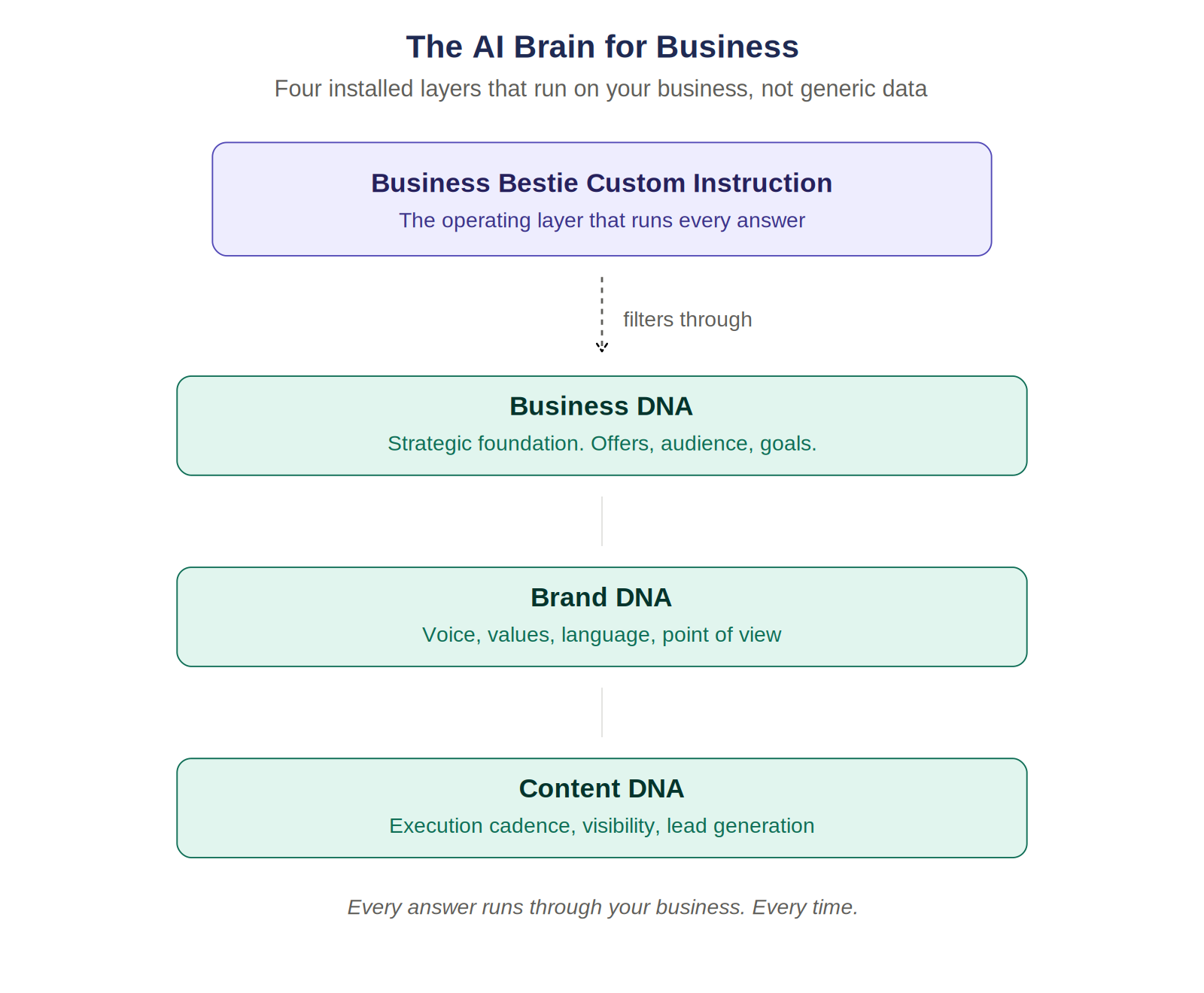
“AI Brain for Business” is my term. When I use it, I mean the installed business context inside the AI model, the intelligence layer you build and load so AI knows your specific business before it answers a single question. The methodology I built to implement it is a specific four-layer architecture: Business DNA, Brand DNA, Content DNA, and the Business Bestie Custom Instruction. I developed this architecture.
The Four-Layer AI Brain Architecture
I’m a strategist and systems builder. Over the past three years I’ve developed, refined, and evolved this methodology inside Content Catalyst with my members and through tailored in-person AI Brain days with clients, where we build the whole architecture specifically for their business.
The AI Brain for Business is built on four layers.
-
Business DNA is your strategic foundation.
-
Brand DNA is your voice and values.
-
Content DNA is your execution cadence, visibility, and lead generation.
-
The Business Bestie Custom Instruction is the operating layer that reads all three and tells AI how to use them in every response.
The first three layers aren’t just documents you fill in. They’re structured diagnostic tools I created, built to ask you the right questions and extract the business intelligence that most owners have in their heads but have never actually articulated. That extraction is the work. The document is the output.
Inside Content Catalyst, members work through the diagnostics in a group coaching environment with my guidance and a Custom GPT I’ve built specifically to run each one. For one-to-one immersion days, we do it together using Claude for a deeper, more tailored process that produces a higher-intelligence output specific to their business.
The tools are designed so you can work through them independently and you absolutely can. But when we do it together, that’s when the real depth happens. I’m not just running you through a questionnaire. I’m bringing thirty years of marketing and business strategy into the session. I push back. I ask the questions you wouldn’t think to ask yourself. I catch the assumptions quietly limiting your positioning, your offers, your messaging and I name them out loud.
Members and clients who’ve done it with me one-to-one say the same thing: “I would never have asked myself that question.” That’s the point. The diagnostic tool extracts your intelligence. Working with me extracts the intelligence you didn’t know you had. It’s a full strategy session. Not light and fluffy.
Why Most People Get Generic AI Output
This is the real reason AI feels broken for most business owners.
They want AI to write their content, draft their emails, build their funnels, and run their marketing. So they jump straight to tools: ChatGPT, Claude, prompt packs, agents, automations.
But they haven’t actually defined the business intelligence that AI needs to run on.
For many business owners, they know broadly who their customer is and what they sell. But they’re often not crystal clear on their ideal customer’s behaviour traits the specific things that accelerate or slow what turns a stranger into a buyer. Many have mapped their customer journey in their head, but it’s not visible on their website. Without that, you can’t make content that actually drives leads. Without clear messaging, brand philosophy, and guidelines, AI is generic.
Without that foundation, even the fanciest AI stack just creates faster confusion.
You can’t automate what you haven’t articulated. Or rather, you can, and the result is faster mediocrity at scale.
The fix is to flip the order. Build business intelligence first. Install it into AI. Then let the automation run on something real.
The Problem With Going Straight to Agents
There’s a whole conversation happening at the leading edge of AI right now. Agents, agent stacks, autonomous workflows. It’s genuinely exciting and genuinely powerful.
But here’s what I see every day inside Content Catalyst, in client work, and in DMs from business owners trying to get AI to work for them: most people are still overwhelmed by the basics. Not because they’re behind. Because they’re busy running a business.
The wins that matter right now are simpler than the hype suggests:
-
Brain dumping every thought into Claude on your phone while you walk the dog
-
Reading your calendar and prepping your day
-
Drafting emails, writing proposals, interpreting data
-
Turning a fifteen-minute walk using voice chat on your phone into a finished product launch
The gap isn’t between basic AI and agentic AI. The gap is between AI overwhelm and AI actually doing the tasks that slow you down.
Foundations first. Then level up. In April 2026, the Australian Cyber Security Centre published guidance warning businesses to build their foundations before deploying autonomous AI agents, because AI amplifies whatever it runs on. Strong foundation, compound results. No foundation, faster mediocrity at scale.
Build the foundation. Add one agent. Then two. Then a workflow. That’s how it compounds.
Why This Is Also a Team Problem
It’s not a team capability problem. It’s a foundation problem.
Without an AI Brain installed, every team member is interpreting “the brand” from memory. From vibes. From whatever AI defaults to when they prompt it. The result is inconsistent output across content, emails, proposals, social posts, everything.
When the AI Brain is installed and the team has access to it, the intern writing a social caption, the VA writing an email, and the founder dictating a proposal are all working from the same foundation. Same voice, same philosophy, same positioning, same audience clarity.
That’s what consistency looks like at scale.
What Delegation Actually Looks Like
Once your AI Brain is installed, AI shifts from generating copy you have to correct into completing tasks you can ship.
Here’s a real example. I open Claude. I dictate one sentence:
“Grab the Google Meet transcript from my email, analyse it for the key action steps, write the proposal, block my calendar for the next scheduled meeting, and drop the email response into my Gmail drafts.”
And it does it. All of it.
Not because Claude is magic, but because it has my AI Brain loaded, Skills loaded and my connectors switched on. It knows my business, my voice, my offers, and my standards. It has live access to my email, my calendar, my documents. So it doesn’t just generate text. It completes the task.
That’s not a chatbot. That’s a personal assistant who was in the meeting, took the notes, and actioned every follow-up while I finished my coffee.
Or my monthly content plan. I ask Claude to write it for the month ahead. Because it knows my offers, my audience, my launch calendar, and my tone, it doesn’t produce a generic content framework. It produces my plan, for my business, promoting my actual offers that month.
A full month of content marketing planning used to take me two days to map out in this detail. Now I do it with a simple instruction from my phone or laptop.
That’s the shift. From chatting with AI to genuinely delegating to it.
Is Your AI Brain Transferable When Models Change?
This is the question many business owners quietly worry about.
When ChatGPT launched, everyone built inside ChatGPT. When Claude got serious, those same business owners had to rebuild everything. That cycle will keep happening.
Your AI Brain is transferable.
The intelligence documents live in structured folder architecture, not inside a single AI platform. When AI shifts, you upload your DNA files into whatever comes next. The AI is the engine. Your Operating System is the infrastructure. Engines change. Infrastructure does not.
I have my AI Brain currently set up on Claude, ChatGPT, Gemini and Perplexity.
When your AI Brain is installed, you don’t get better AI. You get your business, running at full speed, on demand, from your phone or computer.
This Is Part 1 of 5
Over the next few weeks, we go deep on each layer:
-
Part 2: Business DNA: the strategic foundation of your Business Operating System
-
Part 3: Brand DNA: the voice file that stops AI making you sound like everyone else
-
Part 4: Content DNA: the execution layer of your Marketing Operating System
-
Part 5: Business Bestie Custom Instruction: the CEO-level operating layer that pulls it all together
By the end of the series, you’ll have the full blueprint for building your own AI Brain and installing your Business and Marketing Operating Systems.

Ready for Your AI Brain?
Follow along here for the full series, piece by piece.
Or if you want to skip ahead, there are two ways to work with me directly:
-
Ongoing implementation: inside Content Catalyst
-
Tailored AI Brain for Business VIP Immersion: tailored to your business
Explore the AI Brain for Business VIP Immersion
Deb Szabo brings 30 years in marketing to practical AI implementation. She is an AI Business Strategist and Claude Specialist who installs an AI Brain for Business and practical AI systems using the knowledge already inside a business. She passed Claude Certified Associate - Foundations and is registered in the Claude Partner Network.
Get practical AI ideas for your business
Join Deb Szabo's weekly AI for Business Growth newsletter for practical ways to use Claude and AI across your business.
We hate SPAM. We will never sell your information, for any reason.