How to Make AI Understand Your Business: The Business DNA Method
Jun 14, 2026
Part 2 of the AI Brain for Business series.
On Thursday and Friday I ran a two-day immersion with a client where we did a full personalised AI installation. We built their AI Brain for Business inside a governed workspace: the Business DNA, Brand DNA, operating instructions, tools, connectors and human approval points that make AI useful across the business.
There's a lot of ground we cover in those two days, yet we spent the entire first day on one document. Not the skills, not the workflows. One knowledge file about their business.
That file is a master knowledge file about your business. I call it a Business DNA. It's the critical layer that makes AI stop generalising about what you do and stops the robotic sounding AI slop.
In Part 1, I covered why AI defaults to generic output. It's a context problem, not an AI problem. The fix is an AI Brain for Business: the business knowledge and working rules you install so AI can use your real strategy, facts and voice instead of guessing. Business DNA is the commercial foundation. Brand DNA adds positioning, messaging and communication rules.
Here's what you'll walk away with today. What a Business DNA actually is, what goes into it, and why it does three jobs at once. It gives you clarity, it gives your team streamlined knowledge, and it gives AI the context to stop guessing.
What does AI actually need to know about your business?
Everything you've never written down or kept in scattered spreadsheets and notepads.
It's the one document that holds your business intelligence in one place, structured so a person and an AI can both read it. It's the central nervous system of your business. Your goals, your market, your ideal customer, your offers, how you make money, the real problem you solve, and the language you use to describe all of it.
I didn't build it from theory. I built it over three years from two sources. The first was the work itself, three decades in marketing, immersive one-to-one sessions with business owners and hundreds of people in group workshops. Here is where I observed the repeated patterns people needed clarity on. The second was the AI, which kept asking me for the same context over and over before it could produce anything good. I took what came up again and again, and formulated it into a single diagnostic tool.
That's why it does three jobs at once:
- Clarity for you. The act of building it articulates the real bottlenecks and opportunities.
- A source of truth for your team. Your VA, your contractor, and your next hire all work from the same knowledge instead of generalising.
- Intelligence for AI. Load it in and AI stops reaching for the industry average and starts running on your actual business facts.
One document. Three readers. That's the design.
What goes into a Business DNA?
This is where the immersion day goes deep. A Business DNA captures the commercial facts AI needs and maps the business through my five-pillar diagnostic: Brand, Product, Offers, Content and Systems.
The knowledge file covers:
- Strategy and goals. Where the business is now, where it is going and the decisions already made.
- Audience and customer knowledge. Who the business serves, what those people ask and the language they use.
- Products and offers. What is sold, the outcome, price, proof and where each offer fits.
- Revenue Roadmap. The path from stranger to buyer, where people enter, where they converge and the offer at each stage.
- Constraints and opportunities. The practical limits, approval points, bottlenecks and openings AI must respect.
Then we work backwards from the revenue goal and pressure-test each pillar. By the end, you have a map of the commercial engine, the decisions behind it and the path to the goal. That is the part a generic prompt cannot supply.
How long this takes varies. You can pull together a version yourself in about an hour. Done with a strategist's lens and with a business that has some history behind it, it runs much longer, because there's more complexity and more to map out. One of my favourite sayings is you have to slow down to speed up. This is that moment. I pressure test the why, to see if it holds real value and alignment for you.
If you want it built with you rather than alone, that is exactly what the first day of the Tailored AI Brain for Business VIP Immersion is for.
Why messaging clarity is the first thing it fixes
Of everything a Business DNA produces, messaging clarity is the one that changes your results fastest.
Unclear messaging is the single thing I see businesses struggle with, over and over. And it's rarely a writing problem. It's a clarity problem. The message is fuzzy because the business underneath it is fuzzy and often patched together as business growth expands. The offers, the audience, the moving parts of the customer journey. You can't say it clearly until you can see it clearly.
That's why it matters so much. When your Business DNA makes your messaging clear, AI can finally write the things you actually need. Your website copy. Your social posts. Your offers. Your lead magnets. And they convert, because the message underneath them is right.
When the message isn't clear, the opposite happens. Your offers don't convert, not because the offer is weak, but because the words around it are fuzzy and aren't specific enough. Your content talks to everyone, so it lands with no one. Messaging sits underneath all of it.
We run a diagnostic across five pillars: Brand, Product, Offers, Content and Systems. Offers is rarely the first weakness a business owner names, but the diagnostic often reveals an offer or messaging problem underneath the visible symptom. It's the label you can't read from inside the jam jar.
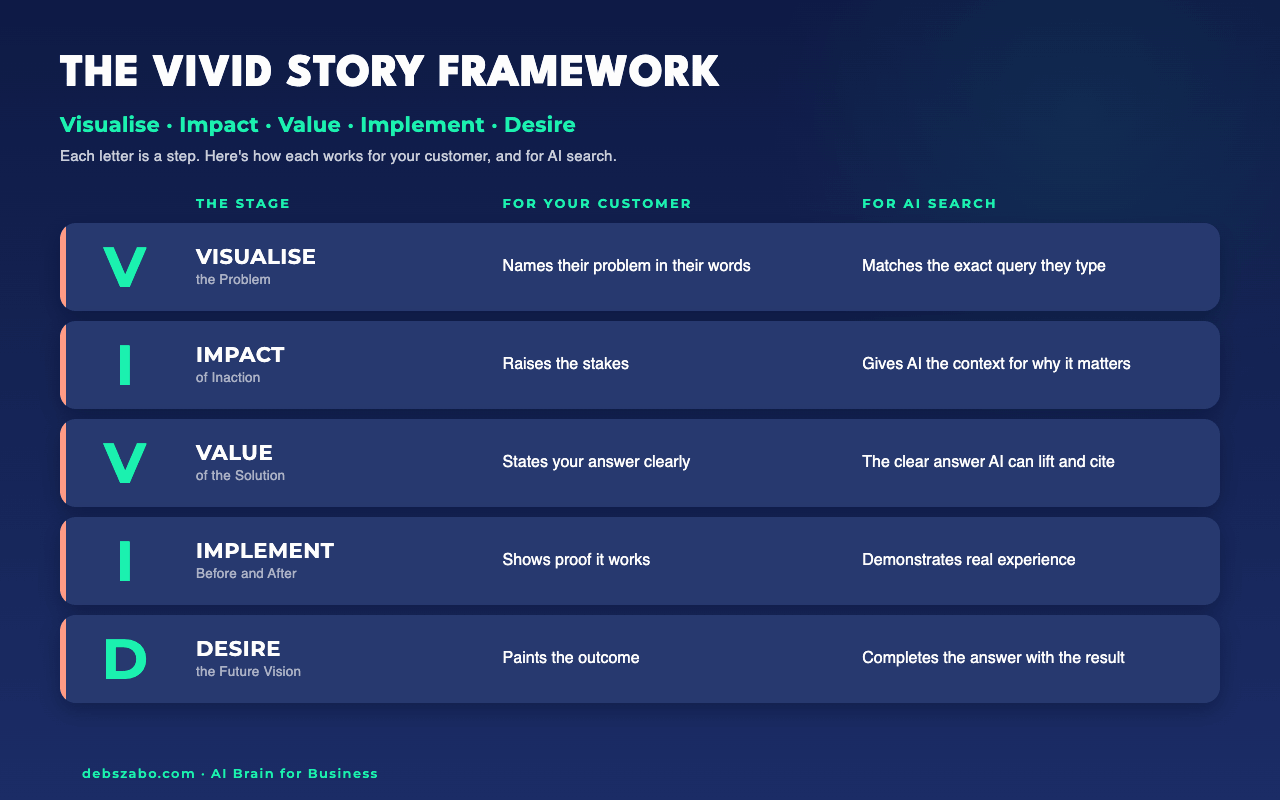
Part of the Business DNA is uncovering search intent and aligning it with your business products and services. Like a matchmaking service. We turn what you do into clear messaging with my VIVID Story Framework. It's the messaging methodology I built and refined over years, and it's the piece that turns your business intelligence into a story that connects and converts. Five stages:
- Visualise the Problem. What your customers are really thinking about.
- Impact of Inaction. Show what it costs to leave it unsolved.
- Value of the Solution. State your answer clearly.
- Implement, Before and After. Show the proof.
- Desire, the Future Vision. Paint the outcome they actually want.
Every stage runs on something the Business DNA captured. The customer's words. Their stakes. Your offer. Your proof. Their desired result. This is how you end up sounding like you and not everyone else.
This is a focused approach showcasing why you're different and better compared to all the other people doing what you do.
Why your Business DNA is also your AI search strategy
This is the part changing fastest in 2026.
Clear messaging still needs to convince people, but it now has a second audience: search and AI systems trying to understand which source answers a question. ChatGPT Search and Claude web search can return answers with links to web sources, while Google's AI Overviews synthesise information and link out for further reading. Specific questions, clear answers, consistent business details and visible evidence make your content easier to interpret and cite.
Two further insights:
- Write the Visualise stage as the actual question your customer types. Not the industry term, their words. "I want to go away somewhere 2 hours from home with my family" is a thought your customer is thinking and a search query at the same time. Your Business DNA should hold a whole list of these, the things your customer searches at 9pm when they can't sleep.
- Write the Value stage as a clear, standalone answer AI could quote in one pass. Vague value lines don't get cited. Definitive ones do. "Our family-friendly accommodation is a 2 hour drive from Sydney."
This isn't theory. It's the exact shift behind how a stranger found me through AI search and booked a call, never having heard my name.
This is why specific, dated and well-structured answers matter. Search and AI systems can only work with what they can find and understand. Clear claims, source links and consistent business details give them less room to guess.
Where does your Business DNA live?
Your Business DNA is a knowledge file, and it's built to be transferable. You create it once, then upload it into any AI tool you use. Claude, ChatGPT, Gemini, Perplexity, and whatever comes next. You're never locked into one platform. The model is the engine. Your Business DNA is the infrastructure. Engines change. Your infrastructure doesn't.
I keep the working version as a Markdown file because it is portable, easy to update and simple to version as the business changes. That is a workflow choice, not a claim that Claude cannot read other formats. Claude supports PDF, DOCX, CSV, TXT, HTML, JSON and other common files. Whatever format you use, give the file clear headings, current facts and a name your team can recognise.
My business runs primarily in Claude, so the same Business DNA is installed wherever the work happens. In Claude Chat, it can sit in a Project knowledge base with project instructions. In Claude Cowork, a local project can carry its own files, context, instructions and memory. In a file-based workspace, a root CLAUDE.md tells Claude how to use the business files and where the approval boundaries sit.
Why this is the foundation layer
Business DNA is layer one for a reason.
The next essential layer is Brand DNA, which gives AI your positioning, messaging, voice and communication rules. Content DNA is added when the work involves content planning or production. The install layer then tells AI how to use that knowledge through settings, instructions and a governed workspace. For teams, Operational DNA and Department DNAs add the processes and decisions each function needs.
But none of those layers can rescue a fuzzy foundation. Voice can't fix unclear. Cadence can't fix unclear. You'd just be making unclear louder.
Business DNA is where you get clear. Everything else amplifies it. Build the knowledge centre first, install it into AI, then let the rest run on something real.
This is the AI Brain Series
Where we're headed next:
- Brand DNA. The voice file that stops AI making you sound like everyone else.
- Content DNA. The conditional layer for content channels, cadence and production.
- The install layer. Settings, instructions and workspace rules that tell AI how to use the knowledge.
- Operational and Department DNAs. The team layer for processes, responsibilities and approval points.
By the end of the series, you'll have the full blueprint for building your own AI Brain for Business.
Subscribe so you get notified when the next article in the series drops.
Want to build your own Business DNA?
Start by gathering the facts that shape how your business makes decisions: your goals, audience, offers, customer language, revenue pathway, proof and the way you communicate. That is the raw material.
If you want the full methodology and implementation path, see AI Brain for Business. It explains the two-day VIP Immersion, what gets installed and how the work connects to practical AI systems across the business.
About Deb Szabo
Deb Szabo brings 30 years in marketing to practical AI implementation. She is an AI Business Strategist and Claude Specialist who created the AI Brain for Business methodology to turn the knowledge already inside a business into useful AI systems. Deb passed Claude Certified Associate - Foundations and is registered in the Claude Partner Network.

Get practical AI ideas for your business
Join Deb Szabo's weekly AI for Business Growth newsletter for practical ways to use Claude and AI across your business.
We hate SPAM. We will never sell your information, for any reason.